
For years, the conversation around data center selection revolved around price per kilowatt, square footage, and contract terms. That conversation has shifted. New research from Futurum Research, based on a survey of 100 IT infrastructure leaders and published in September 2025, found that reliability now outranks every other criterion when organizations choose where to build their next data center network — ahead of ease of integration, ease of operations, and next-generation port speeds.
The reason is simple: the cost of being wrong has gone up. Roughly eight in ten organizations surveyed said a single hour of unplanned network downtime would cause critical internal disruption. Nearly three-quarters expected service disruptions severe enough to threaten customer relationships or breach SLA commitments, and more than two-thirds anticipated direct revenue loss from a single incident.
The survey data undercuts a common assumption — that significant outages are unusual. Among the IT leaders surveyed, about 74% reported at least one significant data center outage in the previous twelve months. Only around a quarter made it through the year without one. A meaningful minority experienced six or more.
What causes them is just as instructive as how often they happen. The two most frequently cited top causes were network device hardware failure and human error — each named by roughly 18% of respondents as a frequent primary cause. Vendor software defects were an occasional culprit for about a third.
Notice what those three causes have in common: none of them are solved by a purchase order. Redundant power and cooling protect against facility-level failure, but they do nothing when a configuration change goes sideways at 2 a.m. or a switch fails in a client cabinet.
The Futurum findings devote significant attention to what the authors call the human factor, and the numbers are striking. More than 80% of respondents said human error affects service continuity at least occasionally. When asked how they manage that risk, the largest group — about 35% — said they rely on strict process discipline and training. Only about 12% believed automation alone could eliminate the problem.
That result is worth sitting with, because it runs against the prevailing narrative. Organizations are investing heavily in automation and AIOps: roughly two-thirds use automated monitoring and alerting, and more than half use infrastructure-as-code or AI-assisted incident detection. Yet the top obstacle to reaching automation goals, cited by 54% of respondents, was a skills gap in automation itself. Nearly half also flagged an inability to see how the network’s current state compares to its intended state.
In other words: the tools are maturing faster than the teams operating them. Automation reduces the volume of routine work, but it does not remove the need for experienced people who can diagnose an unfamiliar failure and act on it immediately.
If reliability is the top criterion and the leading causes of failure are hardware and human error, then the evaluation questions worth asking a colocation provider change accordingly:
The survey also examined how organizations design for fault tolerance. Physical and network-layer redundancy led at 58%, followed closely by application-layer failover at 57% and geographic or multi-site distribution at 56%. Most organizations are layering multiple strategies rather than relying on any single one — a sensible approach, and one that has direct implications for where infrastructure lives.
Geographic distribution in particular is often treated as a cloud problem when it is really a placement problem. A production environment in a corporate closet and a disaster recovery target in a purpose-built facility twenty miles away is a legitimate multi-site design, and it is frequently more affordable than organizations assume.
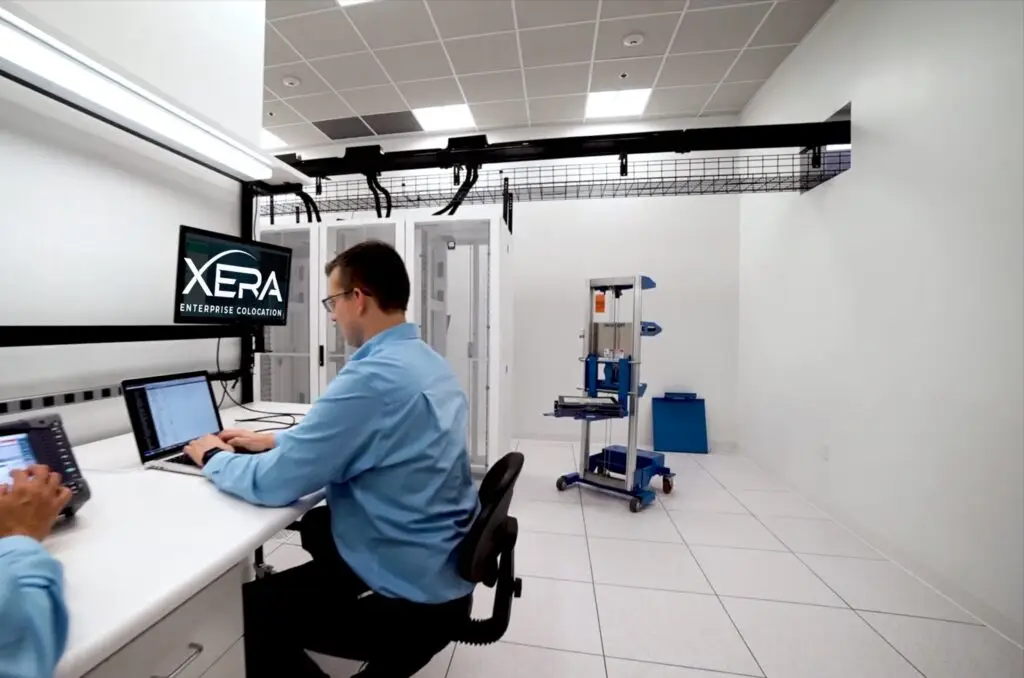
Xera operates a Tier III, carrier-neutral colocation facility in Southfield, Michigan, built around four pillars: power, connectivity, security, and scalability. Our redundant power and cooling infrastructure is designed for concurrent maintainability, so routine service does not require taking client environments offline. Carrier neutrality means clients choose their own providers and build diverse paths rather than inheriting ours.
And critically, we staff the facility with technical support on site — not on call from across town. When hardware fails or something needs hands in a cabinet, response is measured in minutes. That is the layer the Futurum data suggests most organizations are still struggling to cover internally, and it is one of the clearest arguments for colocation over a self-managed on-premises room.
Southeast Michigan businesses evaluating their infrastructure options — whether that is a full migration, a disaster recovery footprint, or high-density capacity for AI and HPC workloads — are welcome to tour the facility and see how it is built.