
When organizations across Detroit, Ann Arbor, Troy, and Sterling Heights evaluate colocation, power and space usually get the first look. But for most workloads, the network is what users actually feel. Every application, transaction, and video call depends on how traffic gets in and out of the building. That makes the connectivity model behind a data center one of the most important and most overlooked decisions in the selection process.
A carrier-neutral data center is not owned by, or tied to, a single network provider. Multiple carriers bring fiber into the facility, and tenants choose which providers they want to buy from. They can also use several at once.
Compare that with a carrier-owned facility. There, the building operator is also the network provider, and your connectivity options are limited to what that one company sells. That arrangement can work, but it ties your network performance, your pricing, and your outage exposure to a single vendor.
Carrier neutrality puts those decisions back in your hands.
With more than one carrier on-site, you can build diverse network paths. A primary circuit from one provider and a secondary circuit from another means a fiber cut, equipment failure, or provider-level outage does not take your environment offline. For community banks, credit unions, and health systems, that diversity supports the resilience expectations built into frameworks such as FFIEC and HIPAA.
When carriers compete for your business inside the same building, you have leverage. You can compare offers, negotiate terms, and switch providers at renewal without physically moving your equipment. Your infrastructure stays put while your network contracts evolve.
Business needs change. A carrier-neutral environment lets you add bandwidth, bring on a new provider, or establish a direct cloud connection as requirements shift. You are not stuck waiting on a single provider’s roadmap.
An internet exchange point (IXP) is a location where networks connect directly to swap traffic, rather than handing it off through third-party transit. Local peering keeps regional traffic regional.
Access to the Detroit Internet Exchange (Detroit-IX) means traffic between Michigan networks, ISPs, and content providers can stay in Michigan instead of routing out of state and back. For businesses serving customers across Wayne, Oakland, Macomb, and Washtenaw counties, that translates to:
Most organizations now run hybrid environments, with some workloads in colocation and others in public cloud. Sending that traffic over the public internet adds variability and exposure.
Software-defined interconnection platforms such as Megaport let tenants provision private, dedicated connections to major cloud providers directly from their cabinet. Bandwidth can be scaled up or down on demand, which suits hybrid architectures, cloud repatriation projects, and disaster recovery designs that span on-premises and cloud.
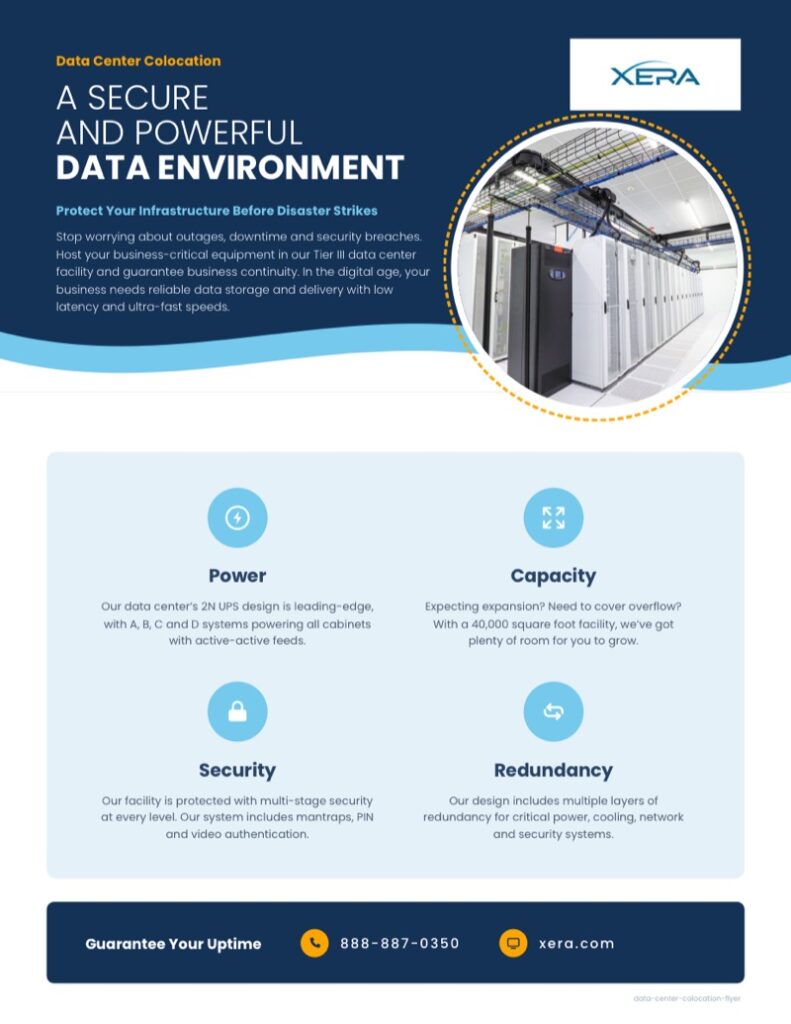
Xera operates a Tier III, carrier-neutral colocation facility at 21005 Lahser Road in Southfield, Michigan, centrally located for organizations throughout Metro Detroit and Southeast Michigan. Connectivity is one of the four pillars the facility is built around, alongside power, security, and scalability.
Your data center should expand your network options, not narrow them. A carrier-neutral facility with local peering and direct cloud access gives Southeast Michigan organizations the redundancy, flexibility, and performance their users expect.
Contact Xera to schedule a tour of our Southfield facility and see our connectivity ecosystem firsthand, or review our Detroit facility specifications.